
How Far Can a Hunting eBike Go on One Charge? Real Range Math
The “up to 60 miles” figure on the spec sheet comes from flat pavement, a light rider, and no gear. A loaded hunting ride is a different machine. Compute the number that matters in watt-hours, not miles.
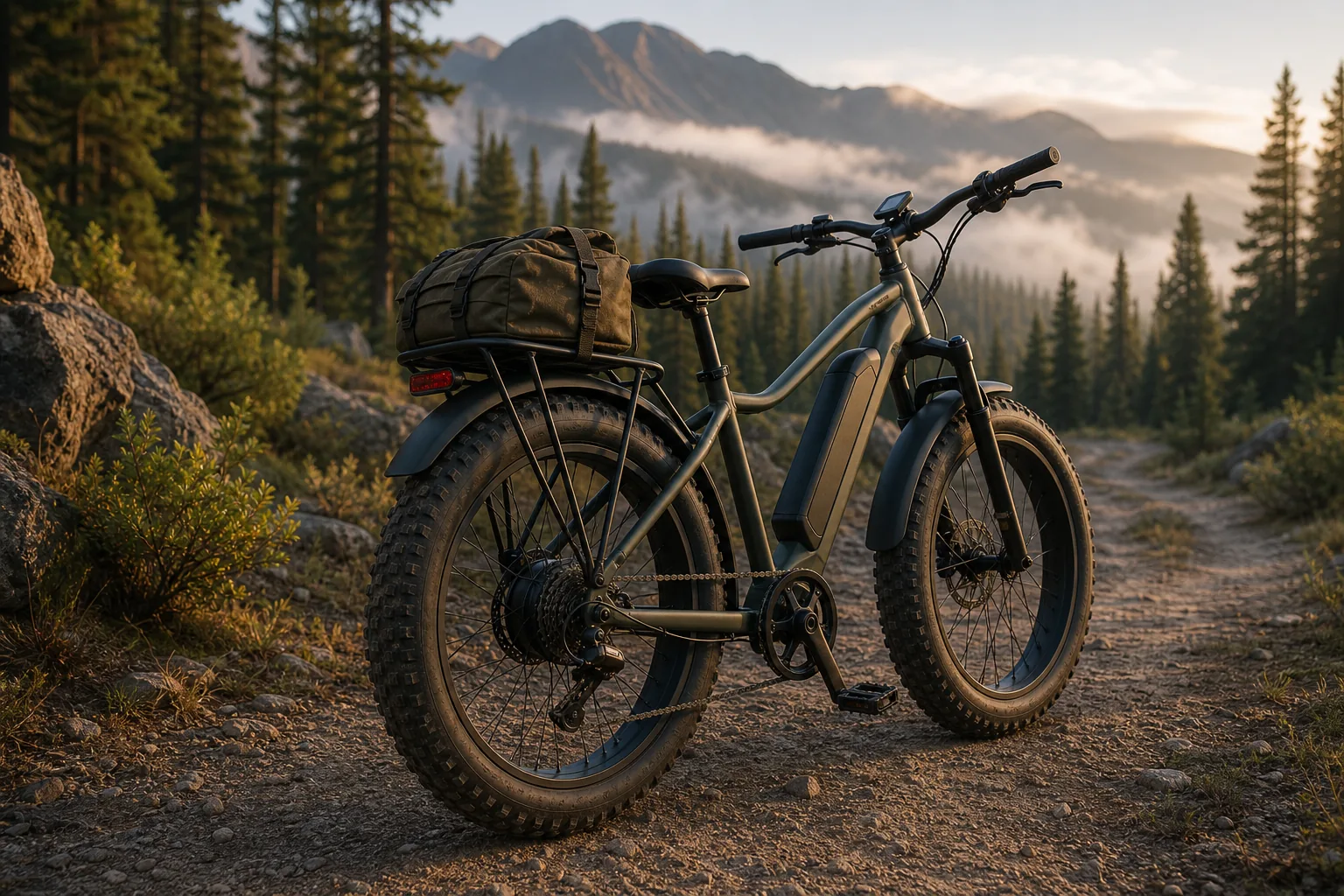
On flat ground with a light rider, many hunting e-bikes spec “up to 50–80 miles” per charge. Loaded for a real hunt — gear, climbs, cold — the honest planning number is roughly 20–40 miles, depending on battery capacity in watt-hours (Wh) and how hard the ride is. The formula: battery Wh divided by the Wh per mile your ride actually burns.
How far can a hunting e-bike go on one charge?
The short answer is a range, not a single number. The same 960 Wh battery (48 V × 20 Ah) covers about 48 mi at 20 Wh/mile on easy ground and about 24 mi at 40 Wh/mile loaded. Both numbers describe the same bicycle; the spec sheet only quotes the first one.
Why every “up to” number is a showroom number
Manufacturers measure range on flat pavement, lowest assist, no cargo, in warm conditions — a controlled test built for fair comparisons, not for predicting a hunt. On a climb, the motor has to work against gravity the whole way.
What counts as a “charge” on dual-battery models
On dual-battery models, the advertised figure usually assumes both packs charged together. Run on one battery, your usable range is roughly half the spec before you switch packs.
Why the advertised range never matches field range
Advertised range is measured on flat pavement, low assist, a light load, in mild conditions — a setup that rarely matches a loaded hunting ride.
| Test condition | Showroom test | Real hunting ride |
|---|---|---|
| Load | Light load, no cargo | Hunter + pack + gear + meat on the way out |
| Surface | Flat, smooth pavement | Trails, mud, snow, loose rock |
| Assist | Lowest setting | Whatever gets you and the load up the hill |
| Temperature | Mild | Cold mornings, ice, wind |
| Speed | Steady and efficient | Stop-and-go, slow grinds, throttle bursts |
What changes when a hunter + gear is on the bike
Every pound of load has to be accelerated, dragged through mud, and lifted up grades. Hunter Bike’s vetting standard for its catalog is a minimum of 250 lb total payload — a bike rated for a hunter plus real gear. That capability comes with a range cost: 280 lb burns more per mile than 220 lb.
Showroom range vs payload-tested range
Hunter Bike does not publish showroom range numbers: its listings carry real-world range data, with payload specs verified before a bike makes the cut. Read “up to” as the ceiling, not the average.
How to calculate your own range in watt-hours
Range = battery capacity in watt-hours ÷ consumption in Wh per mile. Battery capacity in Wh = voltage × amp-hours. That formula replaces every guess.
| Battery (common classes) | Capacity | At 20 Wh/mi | At 30 Wh/mi | At 40 Wh/mi |
|---|---|---|---|---|
| 48 V × 15 Ah | 720 Wh | 36 mi | 24 mi | 18 mi |
| 48 V × 20 Ah | 960 Wh | 48 mi | 32 mi | 24 mi |
| 52 V × 20 Ah | 1,040 Wh | 52 mi | 35 mi | 26 mi |
Battery math and realistic consumption
A lithium-ion battery stores energy in watt-hours — volts times amp-hours (see Lithium-ion battery, Wikipedia). A 48 V, 20 Ah pack holds 960 Wh. Loaded fat e-bikes burn above the commuter figures of 10–30 Wh per mile at about 20 mph (Macfox, 2026; Electric Bike Explorer, 2026; Bike Yard, 2026). Plan with 30–40 Wh/mile for a hunter with gear — your display will provide the live number.
Worked example: 48 V 20 Ah battery, two ride profiles
- Light outing: 20 Wh/mile → 48 mi theoretical.
- Loaded hunt: 40 Wh/mile → 24 mi theoretical.
- Keep a 30% buffer: plan about 17 mi for the loaded outing.
What cuts range fastest on a hunting ride
Payload is the biggest single factor: every extra 100 lb of rider plus gear can add several Wh per mile on climbs, and cold weather compounds it. The factors that drain a charge fastest, in order of impact:
| Factor | Typical effect | What you can do |
|---|---|---|
| Payload | Every 100 lb raised, Wh/mile climbs, especially on grades | Strip the pack to what the hunt needs |
| Climbing | Steep grades multiply consumption on that section | Use the motor deliberately; walk the worst pitch if battery matters more than time |
| Cold weather | Roughly 15–50% range loss depending on temperature (Himiway, 2026; Movcan, 2026; Upway, 2026) | Store the battery warm; keep it close to body heat |
| Headwind | Raises drag sharply at speed | Drop to a lower power ceiling and accept slower miles |
| Tire pressure | Under-inflated fat tires drag on every rotation | Run the pressure for the ground, not the showroom |
| Assist level | Max drains the pack quickly | Match assist to the ground; let the mid-drive work |
Payload, climbing, and cold
Climbing is where the watt-hours disappear: compute the range for the uphill half of the trip, not the loop’s midpoint. Cold and payload are the two factors to plan around — winter guides put lithium-ion energy loss at roughly 15–50% depending on temperature (Himiway, 2026; Movcan, 2026; Upway, 2026). These factors stack: cold plus a heavy load plus a climb is the worst case. However, a heavier battery also adds weight.
Tire pressure, wind, and assist level
Fat tires at low pressure float over mud but drag on every rotation; under-inflated fat tires cost range mile after mile. Wind eats range at speed. And the power setting is a throttle on your battery: eco pedal assist mode keeps consumption low, max climbs fast.
How much range do you actually need for a hunt?
Most backcountry hunts need 5–15 mi of real travel per outing, out and back. A bike with 25+ honest mi of loaded range — before buffer — covers the vast majority of scenarios.
Camp access
3–8 miles in with gear, return empty or light. Traction, not range, is the constraint.
Scouting loop
6–12 miles off-trail, stops to glass, repeated climbs — the range-hungry outing.
Haul-out
A mile or two with a loaded rack and meat. Payload matters more than miles.
The walk-out buffer rule
Plan round trips, not one-way legs. Keep a 20–30% reserve: a headwind, a missed turn, or a longer haul-out than planned will find it. The goal is to get back on battery, not to arrive at zero in the dark. Check your gauge the way you’d check fuel before a long drive.
When a dual-battery bike earns its weight
A dual-battery model earns its weight when the outing is long or the terrain steep. If your hunts stay under about 10 mi round trip, a single well-sized pack with a buffer is plenty. If you scout 15+ mi loops, consider the second pack. Field experience says seasoned hunters overestimate what they need; getting to camp and back with reserve beats raw capacity.
How to test range before you trust it
The honest field test: charge to 100%, ride your real load over your actual ground at the assist you actually use, read Wh/mile from the display, and subtract 20–30% as your planning number.
- Charge fully and record the starting state of charge.
- Load the bike exactly as for a hunt — pack, gear, weight.
- Ride the route you actually hunt, at the assist you actually use.
- Read the display: note Wh/mile and miles covered.
- Divide battery Wh by your Wh/mile for the theoretical range.
- Subtract 20–30% for the buffer. That is your planning number.
- Repeat once in cold conditions — then plan for the worst case you saw.
What the bike display tells you
Modern hunting e-bikes show state of charge, live and average Wh/mile, and estimated miles remaining for your riding conditions. The estimate is only as good as its assumptions — calibrated for a light load, it will overpromise you. Wh/mile does not lie: it is measured on your actual ride.
When to trust a range figure from a dealer
Trust a range figure when the dealer states the conditions it was measured in. Hunter Bike publishes real-world range data with a vetting standard starting at 250 lb total payload — loaded-bike numbers, not showroom. Don’t skip the test ride: it’s the longest day of data you’ll ever get, and one of its benefits is your own Wh/mile. For range news and new-model updates, follow the hunting e-bike guides.
- Compare the Rambo hunting e-bike lineup and BAKCOU backcountry models — dual-battery options included — in the hunting e-bike shop.
FAQ
Can I add a second battery to a hunting e-bike?
Some hunting e-bikes are built for dual batteries: a second pack mounts on the frame and roughly doubles usable capacity when both are charged. Verify the mount and connector with the dealer before buying; not every bike takes a second pack.
Does cold weather really cut range that much?
Yes. Winter riding guides put lithium-ion range loss at roughly 15–50% depending on temperature (Himiway, 2026; Movcan, 2026; Upway, 2026). Keep the battery warm before departure, never charge it frozen, and plan cold outings with the largest buffer of the season.
How many miles is a 48V 20Ah battery?
A 48 V 20 Ah battery holds 960 Wh. At 20 Wh/mile that is about 48 mi theoretical; at 30 Wh/mile, 32 mi; at 40 Wh/mile — a loaded ride — about 24 mi. Subtract a 20–30% buffer and you have the planning number.
Is a mid-drive or hub motor better for hunting range?
Mid-drive motors drive the cranks through the bike’s gears, letting the motor work at efficient rpm on climbs — the better match for loaded, technical terrain. Hub motors are simpler and lighter. Compare both on the same route with your load; Wh/mile on your ground settles the argument.
Sources


