
E-Bike for Hunting Mountains: Grade, Torque & Range
A 2,000-foot climb with 250+ pounds of hunter and gear changes everything about an e-bike. Showroom numbers flatten on the first grade. Here is what actually separates a mountain hunting e-bike from an off-road toy — and how to check it before you buy.
Last updated: August 3, 2026. Fact-checked against the Hunter Bike product line and public sources.
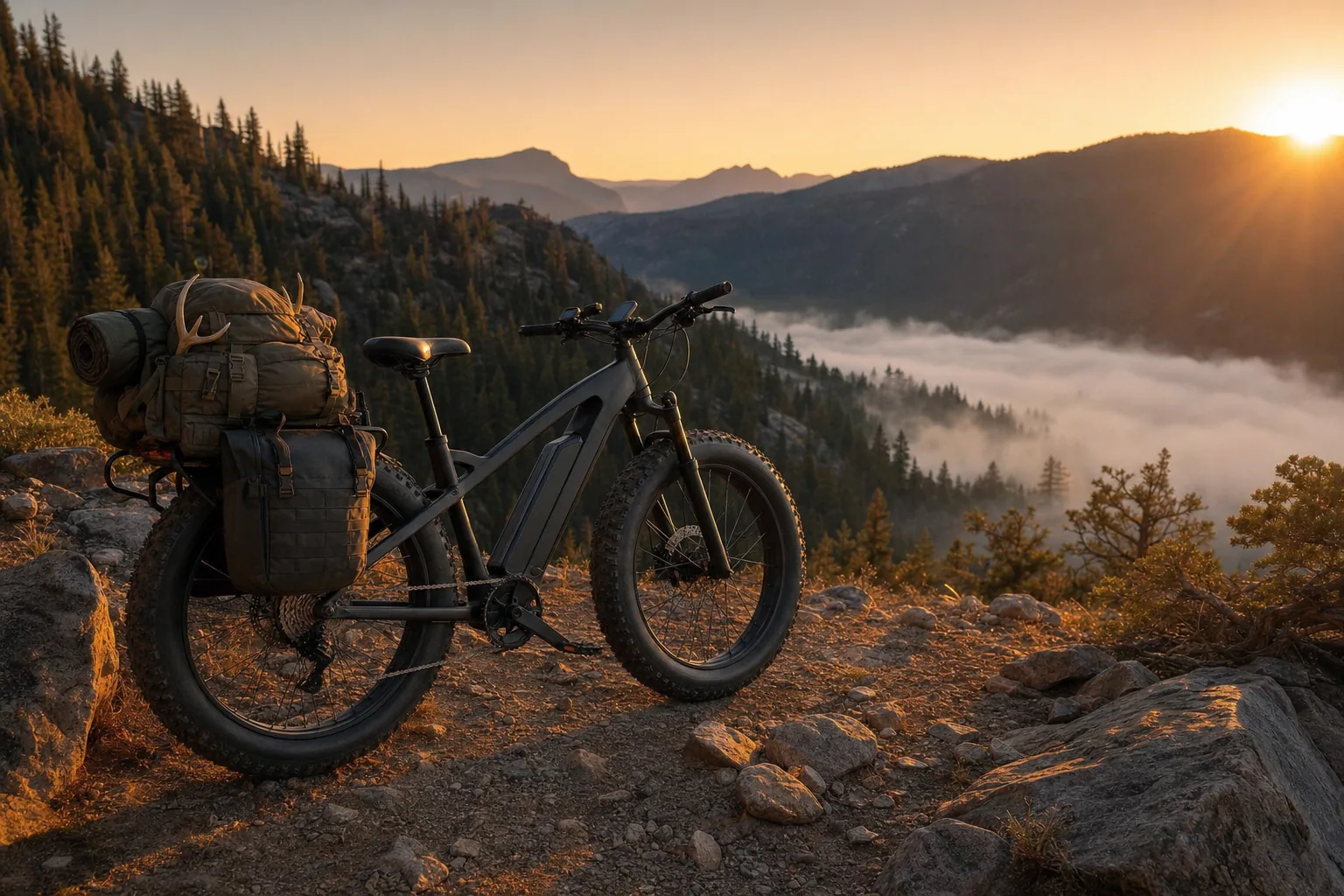
The right ebike for hunting mountains is one that clears three bars: enough motor torque to hold a sustained grade while loaded, enough usable battery capacity (Wh) to cover the round trip at altitude, and enough rated payload for the hunter plus gear — Hunter Bike vets its hunting e-bikes to a 250+ lb total payload standard with real-world, not showroom, range figures.
01What changes when you hunt at altitude
Mountain hunting stacks three loads on one machine: elevation gain, heavy cargo and long distances between roads. Each one attacks a different part of the e-bike — and few of them show up on a spec sheet the way buyers expect.
On a sustained grade, the motor works at sustained power instead of short bursts. That drains the battery far faster than a flat-ground estimate suggests, because power draw scales with climbing work, not with distance. Coming back down, regenerative braking can recover a slice of that energy — but only if the bike is built for it, and never enough to cancel the climb. The honest planning rule is to size the battery for the round trip, not the ride out.
| Condition | What it does to the ride | What to check |
|---|---|---|
| Sustained grade | Motor runs at sustained power; battery drains by climbing work, not flat miles | Motor torque + usable Wh |
| Loaded descent | Weight shifts forward; brakes work harder; regen can recover part of the climb | Hydraulic disc brakes, regen support |
| High altitude | Thinner air, colder temps, longer distances between access roads | Reserve capacity, no range anxiety on the return |
| Soft ground (mud, rocks, snow) | Fat tires float instead of sinking; rolling resistance rises | Fat-tire footprint, traction |
Mechanism, not marketing: these are the physical loads a mountain hunt puts on an e-bike. Exact consumption per mile depends on rider weight, terrain and assist level — it is not a single printed number.
02Three numbers that decide a mountain ebike
Ignore the colorways. Three measurable attributes do the deciding for mountain hunting: motor torque, usable battery capacity and rated payload.
Hunter Bike applies this filter before listing anything: every hunting e-bike in the shop is vetted for build quality, real-world performance and warranty support. The store does not publish showroom range numbers, and it does not sell bikes that max out at 200 lb when the hunter plus gear runs 280 lb.
03How to read a hunting e-bike spec sheet
A mountain hunting spec sheet hides its most important lines in plain sight. Read it in this order and the right bike separates itself fast.
- Frame and weight. Look for a solid frame rated for loaded trail use, and compare total bike weight — a heavier frame often means a stronger build, but it also costs range on the climb.
- Suspension. Front suspension smooths the rocky two-track and keeps control on long descents. Rigid forks work on open ground but punish you on talus.
- Pedal assist and throttle. Most hunting builds offer both. Pedal-assist matters for range efficiency; a throttle helps when you are maneuvering a loaded bike through tight spots.
- Tires. Fat tires are the mountain standard — wide footprint, low pressure, traction on dirt, mud and snow.
- Racks and mounts. Check front and rear rack capacity and the mounting points for gear, cargo and recovery equipment before you plan a load.
- Components. Look for proven transmission and brake components from established brands, and confirm replacement parts are available.
Specs printed on a product page are a starting point, not the whole story. When a line is missing or vague — torque in Nm, usable Wh, rated payload — ask the dealer directly rather than guessing. [À VÉRIFIER] beats an assumption on a $3,000–$12,000 purchase.
04Torque: why motor type matters on a climb
Torque is the rotational force that keeps a loaded bike moving up a grade, measured in newton-meters (Nm). Motor type shapes how that torque behaves, and on steep mountain ground the difference is mechanical, not cosmetic.
A mid-drive motor sits at the cranks and routes power through the bike’s gears, so it can hold a low gear on a climb and keep the motor in its efficient range. A hub motor turns the rear wheel directly; on a slow, loaded climb it draws more current and works harder to hold speed. That is why mountain-hunting buyers usually land on a crank motor — and why our guide on why torque matters on steep terrain goes deeper into the mechanism.
Torque figures in Nm are printed per model; compare them within the same motor type, because a geared crank motor and a hub motor deliver torque differently. If a spec is missing or ambiguous on the product page, ask before buying — [À VÉRIFIER] rather than assume.
05E-bike categories and land access
Where you can legally ride a hunting e-bike depends on its category and on the rules of the land you hunt. Class designations describe motor assist limits, and land agencies apply them differently — federal, state and private lands each set their own standard.
- Class 1: pedal-assist only, motor stops assisting above 20 mph.
- Class 2: pedal-assist plus a throttle, motor capped at 20 mph.
- Class 3: pedal-assist up to 28 mph, typically no throttle.
Before a backcountry trip, check the current land rules for the specific unit, state and season you hunt. Rules change, and a bike that is fine on one forest is restricted on the next — the dealer team at Hunter Bike can walk you through the categories that apply to your hunt.
06Range: plan for the way back
Range on a mountain hunt is a round-trip number, and the way back is the part that fails first. Most published range figures assume flat ground, light rider and low assist — exactly the conditions a hunt is not.
On a 2,000-foot climb, the outbound leg consumes battery at a much higher rate than the return, and the return is not free either: loaded braking and cold weather both cut into what is left. The practical rule is to size usable Wh for the full loop with a reserve, and to read “advertised range” as a flat-ground baseline, not a promise — on mountain trails, the way back is the number that matters.
Hunter Bike publishes real-world range data for its hunting e-bikes instead of showroom numbers, and offers a pre-purchase consultation so a buyer can match battery capacity to the terrain they actually hunt.
07Battery care in the cold and at altitude
Cold air is hard on lithium batteries. At freezing temperatures, usable capacity drops noticeably, so a battery that feels full at home can come up short on a frosty ridgeline. Plan for it the same way you plan for the climb.
- Store and charge warm. Charge the battery at room temperature before the trip and keep it insulated in the pack on the ride.
- Ride with a reserve. Cold cuts into real range; size the loop so the return leg never depends on the last 10% of charge.
- Know your second battery option. Some hunting builds accept a second pack or a range extender — the practical fix for long alpine loops. Confirm compatibility on the product page.
The battery is the most expensive single component on a hunting e-bike. Handle it like the backcountry tool it is, and it will do the same for your hunt.
08Payload: real capacity beats printed capacity
A mountain hunting load is the rider, plus gear, plus game recovery, plus the margin for mud and slope. If the rated payload covers the rider but not the load, the “mountain e-bike” fails on the second ridge.
The standard Hunter Bike vets for is a 250+ lb total payload — hunter plus gear — which is why the store explicitly refuses bikes that max out around 200 lb when a real hunt runs 280 lb. Payload is not a marketing line; it is the difference between a bike that climbs and one that drags.
| Load scenario | Approximate weight | Needed from the bike |
|---|---|---|
| Rider, solo, day trip | 180–220 lb | Base payload spec met by most hunting e-bikes |
| Rider + pack + gear | 240–280 lb | 250+ lb rated payload (Hunter Bike vetting standard) |
| Rider + gear + recovery load | 280 lb and up | Higher-rated models; confirm before buying |
Weight scenarios are typical ranges for illustration, not measured data. Always compare the rated payload on the product spec sheet against your real total load.
09Hunting e-bike vs ATV for mountain access
An ATV gets you deep — until the trail narrows, the gate closes or the game hears you coming. The case for a hunting e-bike is not that it replaces a machine; it is that it covers the ground an ATV cannot.
- Access restrictions. Many backcountry units restrict motorized vehicles while allowing e-bikes under specific category rules — access is often the deciding factor.
- Spooked game. A quiet motor profile and slower approach keep pressure off what you are hunting.
- Carrying the load. An ATV carries more, but a hunting e-bike with a 250+ lb payload carries a realistic hunt load — meat, gear, camp — to places an ATV cannot go.
- Total cost of the hunt. Registration, fuel, maintenance and storage add up on an ATV; an electric bike is a simpler fleet for a one-person hunt.
This is the frame Hunter Bike uses across the catalog — ride where trucks cannot — and it is why the upgrade from ATV to e-bike keeps coming up with mountain hunters.
10Game recovery and cargo
The heaviest minute of a mountain hunt happens after the shot, not before it. Game recovery is where payload, racks and motor torque earn their keep — and where a bike with a thin rating lets a hunter down.
- Rear racks and cargo mounts carry the pack and the camp; check the rated rack capacity, not just the frame rating.
- Trailer compatibility matters for hunters who recover with a cart or trailer behind the bike.
- Hauling gear out — antlers, meat, cold-weather layers — needs the same torque that handled the climb in.
- Balance the load. Keep heavy weight low and centered so the descent stays stable.
When you compare models, add your realistic recovery load to your riding weight and check both the payload rating and the rack spec against that total.
11How to test a mountain hunting e-bike before you commit
Specs narrow the list; a test ride finishes it. Any dealer who sells hunting-grade electric bikes should let you spend real time on the machine, and a pro will set up the test the way a hunt actually goes.
- Climb test, loaded. Ask to add ballast close to your real load and climb the steepest local pitch you can find. Watch how the motor holds speed and how much assist you need.
- Braking test. On the way down, brake hard from speed with the load on. You want predictable hydraulic disc brakes and a frame that stays stable under weight.
- Handling test. Ride through the roughest ground available — rocks, roots, mud. Notice how the bike handles a heavy front end and whether the suspension smooths the chatter.
- Silence test. Cut the assist and coast. A hunting bike should not broadcast your position on a quiet ridge.
- Ergonomics test. Stand, sit, load the rack. Consider how the bike feels when you are carrying weight low and centered — that design detail decides comfort on a long day.
If a dealer will not let you test, that is a signal about the product. The pro argument for buying from a hunting specialist is exactly this: the machine is proven on the kind of ground you hunt, and the support exists before and after the sale.
12Accessories that earn their place on a mountain hunt
A few additions turn a capable hunting e-bike into a backcountry system built to handle the load. Start with the ones that protect the ride, then add the ones that make the hunt smoother.
- Second battery or extender. The single most useful upgrade for alpine loops — confirm compatibility with the bike before buying.
- Proper racks and panniers. Rated cargo mounts keep weight low and centered, which keeps the descent stable.
- High-visibility lighting. Early-morning and late-evening access rides need lights you can trust.
- Repair kit. Tubes, pump, multi-tool, brake pads and a compact chain tool — the difference between a walk out and a ride out.
- Cold-weather gear. Insulated battery cover, glove-friendly controls and layers for the altitude you will ride.
These are simple additions. The point is to plan the whole system — bike, battery, cargo and repair — before the season, not at the trailhead.
13Keeping a hunting e-bike reliable in backcountry
Backcountry reliability is a maintenance habit, not a feature. A hunting e-bike that sits in a garage all year and then climbs 2,000 feet on opening day is asking for trouble. Run a short routine and keep the machine predictable — a pro mechanic check before the season catches problems early.
- Before the season: full inspection — torque on bolts, brake pads, tire sidewalls, spoke tension, battery health check.
- After every ride: wipe mud off the motor and chain, check tire pressure, charge the battery to a safe storage level.
- Monthly: lube the chain, clean and inspect the brake rotors, verify the display and wiring connections.
- Battery: store it at moderate temperature, avoid full discharges, and replace it on the manufacturer schedule.
A simple log — miles, charge cycles, anything that felt off — catches problems before they happen on the mountain. The dealers at Hunter Bike can walk you through the service routine for your model during the pre-purchase consultation.
14Common mistakes mountain hunters make when buying
Most failed hunting e-bike purchases come from the same handful of assumptions. Name them, and the right choice gets easier.
- Buying on peak watts instead of torque. A big watt number sounds fast, but a sustained loaded climb is won by torque and motor type, not peak power.
- Trusting advertised range. Flat-ground, light-rider numbers do not survive a 2,000-foot climb. Size the battery for the round trip with a reserve.
- Underestimating payload. A 200 lb rating disappears the moment you add gear. Add your full load — rider, pack, recovery — before comparing ratings.
- Skipping the descent question. The way down loaded is harder on brakes and control than the way up is on the motor. Plan for both.
- Buying without a test. A spec sheet cannot tell you how a bike feels under your load on your ground. Test it, or at minimum talk to a dealer who hunts the same terrain.
Every one of these mistakes is avoidable. Ask the questions, check the numbers, and the mountain decides in your favor.
15Which mountain hunting ebike fits your hunt?
Match the machine to the mission. The brands Hunter Bike carries — Rambo, QuietKat, BAKCOU, UBCO and Cyrusher — all build hunting-grade e-bikes, but they land differently on torque, range and payload, so the right pick depends on your terrain and your load.
- Hunting-grade mid-drive builds
- Payload-focused lineup
- Specs on product page
- Backcountry and hunt-tested frames
- Torque-oriented motors
- Specs on product page
- Utility/cargo-focused builds
- High payload ratings
- Specs on product page
Every listing is vetted before it appears in the mountain e-bike range at Hunter Bike, and the team will talk through terrain, state land rules and payload before you commit — the same conversation we run for the all-terrain electric bike for hunting and the Eunorau hunting e-bikes in the catalog.
16Budget and the honest pros and cons
Mountain-ready hunting e-bikes sit in the $3,000–$12,000 segment — a real investment, and one that deserves a straight answer about where the money goes. You are paying for rated payload, real-world range data, proven components and support that a big-box listing does not carry.
- Pros: quiet approach, trail access where ATVs are restricted, 250+ lb payload capacity for a realistic hunt load, low running cost, one-machine fleet for a solo hunt.
- Cons: real investment up front, range is finite on a long alpine loop, battery care in the cold, and the bike will not match an ATV’s raw carrying capacity.
Financing is available on Hunter Bike hunting e-bikes, and the pre-purchase consultation is free — the idea is to match the machine to the hunt before you spend, not after. A great fit for your terrain is worth more than a smooth spec sheet, and an honest sales conversation is part of the high-ticket purchase.
- Check torque (Nm) and motor type before comparing models — a crank motor behaves differently on a climb.
- Size usable Wh for the round trip at altitude, with a reserve; advertised range is a flat baseline.
- Rated payload must cover hunter + gear — Hunter Bike vets to 250+ lb total.
- Descent control matters: hydraulic disc brakes and regen are part of the mountain equation.
- Confirm the e-bike category and land rules for the unit you hunt before you ride.
FAQ
How much torque do you need for a hunting ebike?
Enough to hold a sustained grade while loaded — which is more about motor type than a single Nm number. A geared crank motor works through the gears, so it can climb slowly without stalling; a hub motor on the same grade draws more current and works harder. Compare the printed Nm figure within the same motor type, and confirm the payload the bike is rated for. When a spec is missing, ask the dealer rather than assume.
How far can a hunting ebike go in the mountains?
As far as the usable Wh in the battery takes a loaded round trip — not as far as the advertised range suggests. Climbing drains the battery by work done, so a 2,000-foot ascent can consume several times the flat-ground energy per mile. Plan the loop with a reserve, read published range as a flat-ground baseline, and confirm real-world range with the dealer for your terrain and load.
What kind of electric bike handles steep hunting terrain?
A fat-tire crank-motor hunting electric bike with a 250+ lb payload rating, hydraulic disc brakes and enough usable Wh for the round trip. Fat tires keep traction on mud, rocks and snow; the crank motor holds a low gear on sustained grades; the payload rating covers hunter plus gear; and strong brakes control the loaded descent. Hunter Bike vets its hunting lineup against exactly these standards.
Sources
- Wikipedia — Electric bicycle (motor types, e-bike classes, range factors; accessed August 3, 2026)
- Wikipedia — Regenerative braking (energy recovery on descent; accessed August 3, 2026)
- Hunter Bike brand playbook — vetting standard (250+ lb payload, real-world range, warranty support), product pages and pre-purchase consultation.


