
Hunting eBike Battery Care in Cold Weather
A lithium-ion battery loses range below zero because the chemistry slows down. Recharge it at indoor temperature, store it around half full, and plan for a shorter ride. That routine keeps a hunting e-bike battery healthy all season.
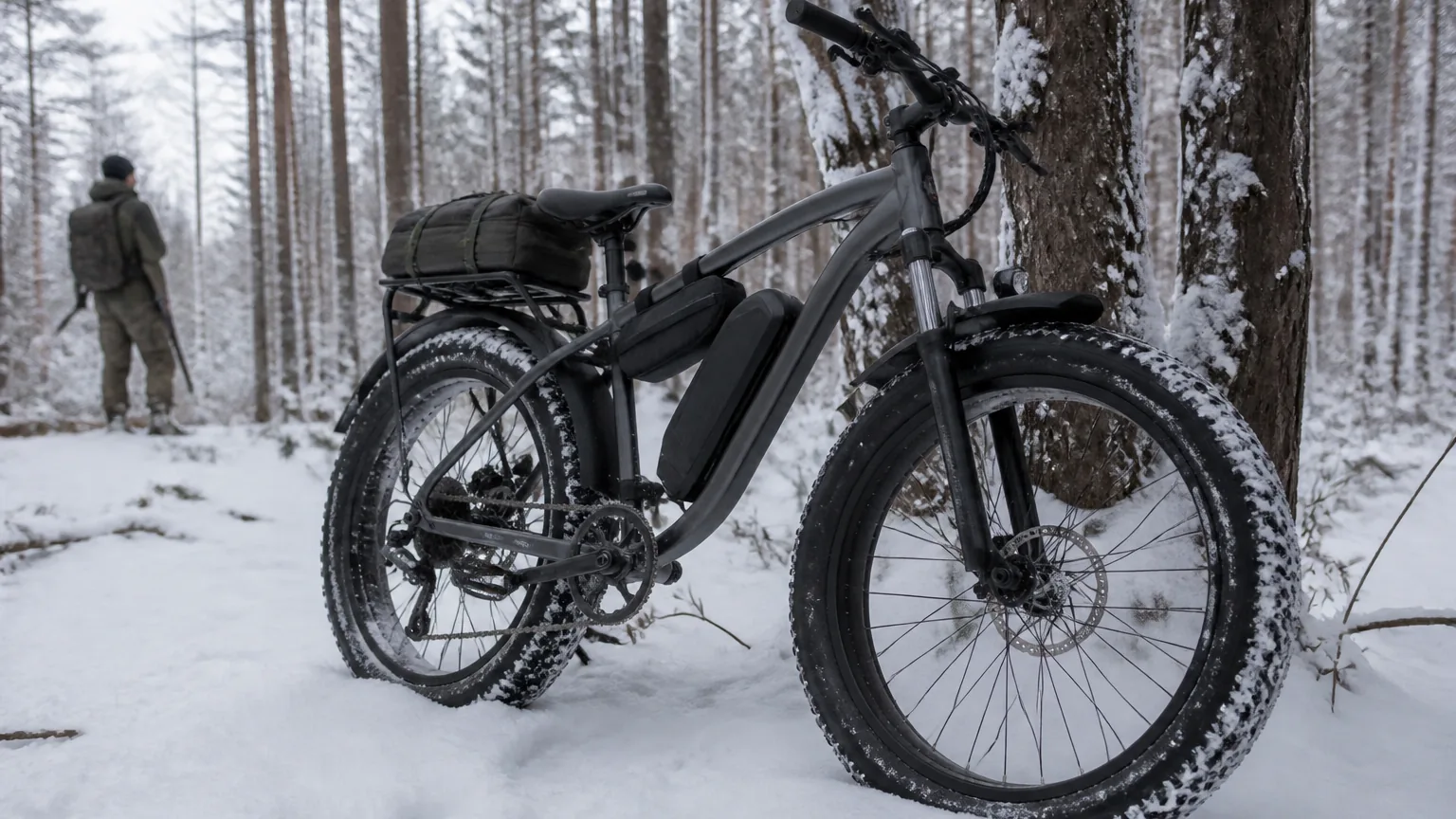
If you hunt late season with an electric bike, you have already seen it: the range meter drops faster on an icy morning, and the bike feels weaker until the battery warms up. It’s not a defect. Cold slows the chemical reaction within the pack, so less power is available and the battery drains sooner. The fix is a simple routine: always recharge at indoor temperature, keep the pack warm before a ride, store it at the right state of charge level, and respect the temperature limits your battery actually has. This guide covers every step, with the real specs of the batteries we sell.
01Why cold weather drains your hunting e-bike battery
Cold weather slows the electrochemistry within the pack. The battery still holds its energy, but less of it is available at low temperature, and the voltage sag under load is larger. The practical result: reduced range, weaker acceleration on a cold pack, and a significantly faster drop on the display. The capacity returns when the pack warms up — riding in the cold does not permanently damage the cells (Battery University, “Charging at High and Low Temperatures”, batteryuniversity.com).
| Effect | Why it happens | What you can do |
|---|---|---|
| Lower range | Slower chemistry, less usable output | Plan shorter rides, keep the pack warm |
| Voltage sag under load | Higher internal resistance when cold | Heat the pack before departure |
| Slower recharging | Charging is limited below zero | Recharge indoors, never a frozen pack |
Takeaway: a cold pack is a slower pack, not a broken one. Warm it, ride within its real range, and it will come back in spring.
02Charging rules in cold conditions
Never recharge a pack that is frozen. Charging pushes lithium ions into the anode; at low temperature the process can deposit lithium metal instead, which damages the cells over time. Bring the pack to indoor temperature first, then plug in the proper charger (Battery University, temperature effects on charging).
| Action | Do | Don’t |
|---|---|---|
| Temperature | Recharge at indoor temperature | Recharge a frozen pack |
| Charger | Use the matching 48V charger | Mix chargers or voltage |
| Place | Ventilated indoor spot | Recharge on snow or damp ground |
| After a ride | Let the pack warm before recharging | Plug in right after a cold ride |
What “recharge indoors” really means
It means the pack comes off the bike and goes into a dry indoor spot at normal home temperature — not a cold garage, not a truck bed. A few hours at normal room temperature is enough for a pack that has been out in the cold. Then connect the correct charger and let it finish. Most riders recharge overnight, which is fine with a proper charger.
Takeaway: warm first, recharge second. The ten minutes it takes to bring the pack inside is enough to protect the cells for years.
03How much range you lose — and how to plan rides
Expect a noticeable range drop in cold weather, especially below zero. The exact number depends on the battery, the load, and how cold it is — so we do not print fake percentages here. Plan for shorter outings, carry the pack warm, and use pedal assist more aggressively to reduce the drain and stretch the ride.
| Condition | Range impact | Best practice |
|---|---|---|
| Mild cold (above freezing) | Small drop | Normal planning, warm storage |
| Freezing (below 0°C / 32°F) | Noticeable drop | Keep the pack warm, shorten routes |
| Deep cold (well below freezing) | Large drop | Insulate, recharge at home, pedal assist |
Keeping the pack warm before a ride helps. If the machine stays outside, remove the battery and keep it indoors as long as possible. On the trail, a pack that has been riding produces its own heat, which improves efficiency — the first minutes are the weakest.
Takeaway: treat range as a budget you manage. A warm pack, assisted pedaling, and a shorter planned loop keep a cold-weather hunt realistic.
04Storage between rides and over the off-season
Store a lithium-ion pack around 50-60% state of charge, in a dry, cool spot indoors. Do not store it fully charged for months, and do not store it empty. A partial charge minimizes stress on the cells during long idle periods — a simple way to prevent capacity loss over time.
Place dry, cool indoor
Remove from the bike
Check every few weeks
| Step | Why |
|---|---|
| Charge to about 50-60% | Balances cell stress vs self-discharge |
| Remove from the bike | Stops parasitic drain and cold exposure |
| Keep in a moisture-free place | Prevents moisture damage to the casing and contacts |
| Top up every few weeks | Keeps the pack in the safe range |
Off-season routine for a hunting season rhythm
Hunting season has a natural pause between late winter and the next opening. Use that pause: bring the pack to about half charge, clean the contacts, and store it inside. At the start of the season, give it a full charge cycle and check the range on a short ride before a long hunt.
Takeaway: the off-season is where batteries are won or lost. Half charge, a dry spot, and a check every few weeks is the whole routine.
05Winter care for your HunterBike battery (real specs)
Our hunting e-bikes run on 48V lithium-ion packs, and we sell the replacement parts directly. The Eunorau Specter replacement battery uses Samsung 35E 18650 cells in a 13S5P configuration, rated 48V and available in 14Ah or 17Ah (672/816Wh). Its manufacturer spec lists a storage temperature of -20 to 40°C — a survival limit, not a charging limit.
That -20 to 40°C spec tells you the pack can survive the cold, but it does not mean you should recharge it at -20°C. Charging is a different regime: indoor temperature, proper charger, safe location. To ensure you have the right gear, the matching 48V 2A charger is in the shop.
Takeaway: read the storage spec as a survival limit, not a use recommendation. The routine — heated charge, half charge, a safe spot — keeps the pack at full performance.
06FAQ
Can I charge my e-bike battery in freezing temperatures?
No. Recharging a frozen lithium-ion pack risks cell damage. Bring it to indoor temperature first, then plug in the matching charger in a dry place.
How should I store my e-bike battery for the winter?
Around 50-60% state of charge, in a dry, cool spot indoors, removed from the bike. Top it up every few weeks to keep the pack in the safe range.
Why does my e-bike battery drain faster in cold weather?
Cold slows the chemistry inside the pack, so less capacity is available and the battery drains sooner. The capacity returns when the pack warms up.
Does cold weather permanently damage my battery?
Riding in the cold does not permanently damage the cells — it just reduces available range. The damage risk comes from recharging below freezing or storing at extreme states of charge for months.
Need a spare pack or charger for the season? See the Eunorau Specter replacement battery and the matching 48V 2A charger in the shop.
Sources
- Battery University — “Charging at High and Low Temperatures”: lithium-ion charging limits and cold effects — batteryuniversity.com (accessed August 2026).
- HunterBike product catalog (first-party, scraped 2026-08-06): Eunorau Specter replacement battery specs — 48V, 14/17Ah, Samsung 35E 18650, 672/816Wh, storage -20~40°C, 13S5P; Eunorau 48V2A charger.
- SERP analysis, US market (internal, August 2026): 20+ competitor documents for “hunting ebike battery care in cold weather” — length target 1,498 words.


